

What are the laws around school attendance?
Statutory Guidance from the Department for Education (DfE) called Working Together to Improve School Attendance came into force on 19th August 2024 underpinned with new legislation The School Attendance (Pupil Registration) (England) Regulations 2024.
The new guidance gives clear responsibilities to ‘everyone’ involved in the care of a child and clearly connects that absence from school is classed as a safeguarding concern in terms of ensuring the whereabouts of every child is concerned and in exploring absence when the level of attendance is of concern.
It also reinforces the duties of both schools and parents in respect of attendance which are outlined in The Education Act 1996. All children who are of compulsory school age (from the start of the term after they turn 5 years old, until the last Friday in June of their 16th year) must receive an education at school or otherwise. A child’s parent(s) (or carer(s)) is responsible for ensuring this happens under this act and where a child is over compulsory school age the parent(s)/carer(s) have a duty to encourage their participation in education or training up to the age of 18 under Part 1 of Education and Skills Act 2008. Where a parent/carer fails to ensure a child receives education, s444 of the above act states they may have committed an offence.
Term Time Exceptional Absence from School
Family holidays or absence due to recreation or leisure purposes are not allowed to be taken during school term time. While family holidays are enriching experiences, the school year is designed to give families the opportunity for these breaks without having to disrupt their children’s education (175 non-school days).
As set out in The School Attendance (Pupil Registration) (England) Regulations 2024, headteachers continue to have the power to authorise leave of absence, but only when requested in advance and for exceptional circumstances; each case should be considered on its own merits. It is for schools to consider the specific details and relevant context behind each request. If the absence reaches the national threshold of 10 unauthorised sessions of absence in a rolling 10 school weeks a legal sanction can automatically be considered. See below Penalty Notices and Legal Sanctions Section.
Under the new legislation and guidance, Schools/Academies MUST also now share data with the DfE daily, and with the Local Authority when they are admitted or deleted from the school roll. Also, data must be shared with the LA once:
- A child’s attendance shows they have had 10 continuous absent sessions,
- If a child has 15 days of illness (continuous or accumulative) or they are likely to have (this could lead to education being provided by the LA if health professional evidence is clear the child cannot attend the school).
N.B. To clarify, the ‘10 weeks’ is not fixed, and is a trigger period for schools to identify if there may be a concern with attendance. Any legal action that is subsequently taken may be for a longer period if addressing multiple absences but it may be shorter if dealing with a specific single period of absence of 10 sessions or more e.g. for an unauthorised holiday of 1 week.
The 10 sessions can be made up of any combination of unauthorised absence, examples of this are:
- 4 sessions of ‘holiday’ taken in term time plus 6 sessions of arriving late after the register has closed (U codes) within a 10-week period.
- 10 sessions within one week or spanning over the end/start of 2 weeks.
- 6 sessions of ‘holiday’ in week 1 followed by 4 sessions of absence on subsequent weeks.
- 4 sessions at the end of one half-term or term, followed by 6 sessions at the start of the next half-term or term. Terms can also be in different academic years.
- 10 sessions taken as individual or consecutive days over a number of weeks but within a 10-week period.
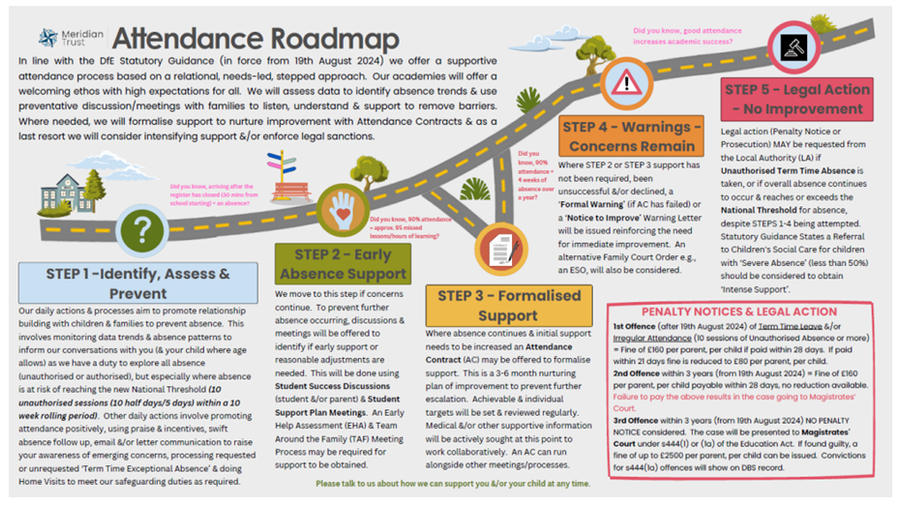
Penalty Notices and Legal Sanctions.
Once the national absence threshold has been met, schools have a duty to consider:
- If support is required
- If a Penalty Notice is required
- If another type of legal sanction is required
I hope you will have gleaned from all the above information that using legal action is not a preferred route, as our intention, ethos and process is always a ‘support first’ approach. However, where support is not engaged with, or declined the duty placed on schools is to inform the LA so that formal consideration of legal action can be taken.
Penalty Notices fines were introduced under Section 23 of the Anti-Social Behaviour Act 2003 and are issued under The Education (Penalty Notices) (England) (Amendment) Regulations 2007 & amendments 2012, 2013 & 2024. The fines are set by the Government; the school does not receive the fine, and they are used as an alternative to prosecution where a parent is given the opportunity to discharge their liability by paying the penalty. All Penalty Notices are issued as per the academy’s Local Authority Code of Conduct.
Parents must have received a warning that a Penalty Notice may be considered prior to one being issued. When the absence is due to a single period event, e.g. a Term Time Absence of 10 unauthorised sessions or more, due to non-exceptional reasons (e.g., holiday), parents will have received a warning either advising them their request is not authorised or they have not followed due process and the absence taken is not authorised, and both letters would state a Penalty Notice will be requested.
Where the absence is for a multiple absence period, and it is deemed that support may be required to help the family improve the attendance, a meeting must be offered to discuss what support may be required. This will often include the offer of and Early Help Assessment or other LA Early Help Pathway Referrals, and it may also include an Attendance Contract where the school and wider support networks can collaborate to pool resources.
Once it has been identified that support is not something that is required or wanted, a Legal Warning Letter will be issued giving notice to parents that attendance must improve. A timescale in which to demonstrate significant improvement in attendance will be given in the letter so that attendance can be monitored before a legal sanction is issued.
Only 2 Penalty Notices can be issued to the same parent in respect of the same child within a 3-year rolling period (the 3-year period starts 19th August 2024). If there is need for further action following 2 Penalty Notices being issued, alternative action should be taken instead e.g., prosecution in the Magistrates’ Court or other formalised legal intervention.
Penalty Notices are currently (as @ Sept 2024) £160 per child, per parent, if paid within 28 days of receipt of the notice but this is reduced to £80 per child, per parent, if paid within 21 days of receipt of the notice.
Following the receipt of all required documentation the Local Authority will decide whether to issue the requested Penalty Notice(s). The Local Authority will liaise directly with the Academy at each stage of following a penalty notice being issued. If the penalty is not paid in full by the end of the 28-day period, the Local Authority must either prosecute or withdraw the notice.
Where a 2nd Penalty Notice is issued to the same parent in respect of the same child the Penalty Notice will be charged at a flat rate of £160 to be paid within 28 days (no reduction for early payment will be allowed). Further offences will be dealt with by prosecution in the Magistrates Courts.
Please Note:
- If the LA feel a Penalty Notice would not be effective they can decide not to offer parents the opportunity of a Penalty Notice and take a case through the prosecution route instead. They may do this where they see repeated absence patterns, even if the individual absence events do not meet the national absence threshold.
- Only the Local Authority can withdraw a penalty notice and they can only withdraw it if; it ought not to have been issued i.e., no offence was committed; it has been issued to the wrong person; or it contains material errors.